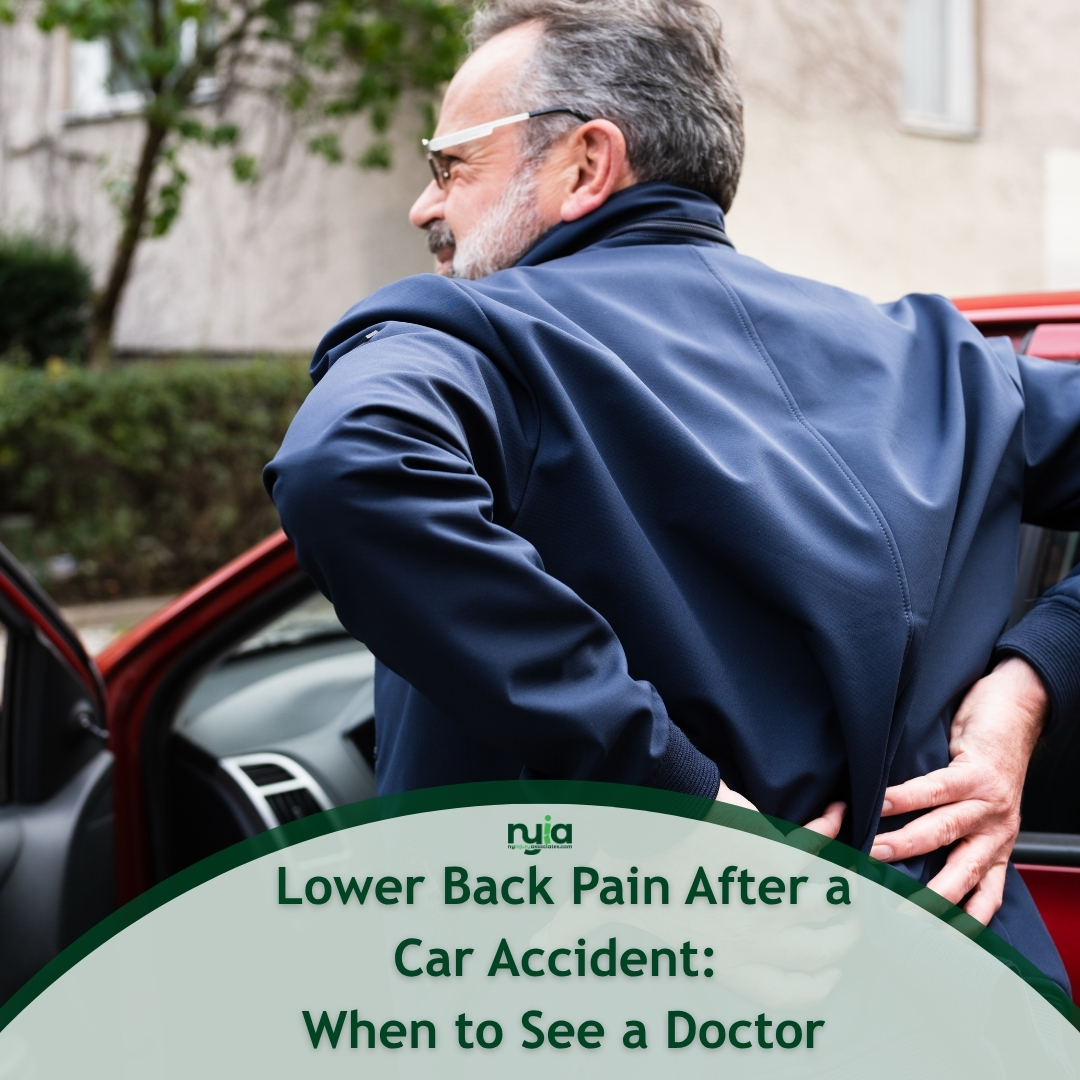
You should see a doctor for lower back pain after a car accident within a few days, even if the pain seems mild. Go to the emergency room right away if back pain comes with loss of bladder or bowel control, numbness in the groin or inner thighs, new weakness in your legs, or severe pain after a high-speed crash. Back injuries often hurt more in the days after a collision than at the scene, and an early exam rules out serious damage and starts the medical record your no-fault claim depends on.
New York Injury Associates is an independently owned and operated group offering evaluations and treatment in chiropractic, physical therapy, pain management, orthopedic, neurological, and other specialties. If you were hurt in a crash on Long Island or in Queens, we can connect you with the right provider at one of our 16 offices. Request an appointment or call 631-305-2394 (Suffolk) or 516-558-5644 (Nassau and Queens).
Why Your Lower Back Can Hurt Days After a Crash
In a collision, your body is thrown forward, backward, or sideways while your seat belt holds your hips in place. That sudden motion can stretch and tear the muscles and ligaments of the lower back, or compress the discs between the vertebrae.
At the scene, adrenaline can mask pain. Inflammation then builds over the following hours and days, so many people first notice stiffness or soreness the next morning or a day or two later. Delayed pain is common and does not mean the injury is minor.
Common Causes of Lower Back Pain After a Car Accident
Muscle strains and ligament sprains. These soft-tissue injuries are the most common cause of back pain after a crash. They cause aching, stiffness, and muscle spasms, and they usually improve with time and active treatment.
Herniated or bulging discs. The force of a crash can push the soft center of a spinal disc outward, where it can press on a nearby nerve. This can cause sciatica: pain, numbness, or tingling that runs from the lower back through the buttock and down the leg.
Facet joint injuries. The small joints at the back of each vertebra can be jarred or strained, causing pain that worsens when you lean back or twist.
Sacroiliac (SI) joint injuries. The SI joints connect the base of the spine to the pelvis. An injury here often causes pain on one side of the lower back or buttock.
Spinal fractures. High-speed crashes can crack a vertebra. Compression fractures are also more likely in older adults and people with osteoporosis, sometimes even in lower-speed collisions. Fractures need prompt imaging and medical care.
Symptoms That Mean You Should See a Doctor
Make an appointment with a doctor within a few days if you have lower back pain after an accident, and sooner if you notice any of these:
- Pain that is not improving after a few days, or is getting worse
- Pain that spreads into your buttock or down your leg
- Numbness, tingling, or a pins-and-needles feeling in a leg or foot
- Back stiffness that limits bending, sitting, driving, or sleeping
- Muscle spasms that keep coming back
- Pain that is worse at night or does not ease with rest
- Trouble standing up straight or walking normally
When to Go to the Emergency Room
Call 911 or go to the nearest emergency room right away if back pain comes with any of these:
- Loss of bladder or bowel control, or new trouble urinating
- Numbness in the groin, genitals, inner thighs, or buttocks (the area that would touch a saddle)
- Weakness in one or both legs that is new or getting worse
- Severe back pain after a high-speed or rollover crash
- Back pain with fever, or with severe pain in the abdomen
The first three can signal cauda equina syndrome, a rare condition in which the nerves at the base of the spine are compressed. It is a surgical emergency, and fast treatment can prevent permanent damage.
Why You Shouldn’t Wait to See a Doctor
Even when back pain feels manageable, an early exam matters for three reasons. A doctor can rule out a fracture or nerve injury that symptoms alone may not reveal. Starting the right treatment early can help you recover faster and avoid long-term pain. Your medical records also connect your injury to the accident, which matters for your no-fault claim and any legal case.
What to Expect at Your First Visit
Your provider will ask how the accident happened and when your symptoms started, then check your range of motion, strength, reflexes, and sensation. Not everyone needs an X-ray or MRI right away. Providers order imaging when the exam or type of crash suggests a fracture, a disc injury pressing on a nerve, or another problem that a scan would change the treatment for.
Treatment Options for Lower Back Pain After an Accident
Most lower back pain from a car accident improves without surgery. Depending on your injury, your treatment plan may include:
- Chiropractic care, including spinal adjustments and soft-tissue work to reduce pain and restore movement
- Physical therapy to strengthen your core and back muscles, improve flexibility, and prevent re-injury
- Pain management, which may include injections when a disc or nerve problem causes ongoing pain
- Orthopedic care for fractures, severe disc injuries, and cases that may need surgery
- Neurology for numbness, tingling, or weakness that suggests nerve involvement
At home, staying gently active is usually better than bed rest for most back injuries, unless your provider tells you otherwise. Heat can ease muscle tightness. Ask your provider before taking any pain medication, especially if you take other medicines or have other health conditions.
How New York No-Fault Insurance Covers Your Treatment
In New York, no-fault insurance (also called personal injury protection, or PIP) pays for necessary medical treatment after a car accident, no matter who caused the crash. Basic coverage is up to $50,000 per person for medical bills, lost earnings, and certain other expenses. Within that limit, lost earnings are paid at 80%, up to $2,000 per month, for up to three years. No-fault does not pay for pain and suffering.
To protect your benefits:
- File the no-fault application (form NF-2) with the correct insurance company within 30 days of the accident. Missing this deadline can cost you your benefits.
- See a doctor promptly, so your injuries are documented from the start.
- Your health care providers must submit their bills to the insurer within 45 days of each treatment.
- Submit any lost-earnings claims within 90 days.
- Attend any independent medical exam (IME) the insurer schedules.
If you were driving, file with your own insurer. Passengers file with the insurer of the vehicle they were in, and pedestrians generally file with the insurer of the vehicle that hit them. If you were driving for work, workers’ compensation may apply instead. Learn more in our guide to whether a no-fault accident affects your insurance.
New York Injury Associates practices accept no-fault insurance. If you have an attorney, your provider can prepare a medical narrative report for your case.
Frequently Asked Questions
How Long After a Car Accident Can Back Pain Start?
Back pain can start right away or appear hours to a few days later, once adrenaline wears off and inflammation builds. Delayed pain is still worth having checked.
How Long Does Lower Back Pain From a Car Accident Last?
Many muscle strains and sprains improve within a few weeks with treatment. Disc injuries, joint injuries, and fractures can take several months. If pain hasn’t improved after a few weeks, it should be re-evaluated.
Should I See a Chiropractor or a Medical Doctor for Back Pain After an Accident?
Both can help. A chiropractor can evaluate and treat many soft-tissue and joint injuries, and a medical doctor can order imaging, prescribe medication, or refer you to a specialist. Because NYIA is a multi-specialty group, we can match you with the right type of provider for your symptoms.
Can I See a Doctor If I Already Went to the ER?
Yes. The emergency room checks for life-threatening injuries. Follow-up care for the back injury itself usually happens with a chiropractor, physical therapist, orthopedist, or pain management specialist.
Does No-Fault Cover Chiropractic Care and Physical Therapy?
No-fault covers necessary medical treatment related to the accident, which can include chiropractic care and physical therapy, up to your policy limits.
Find a Doctor Near You
New York Injury Associates has offices across Suffolk County, Nassau County, and Queens:
- Suffolk County: Amityville, Bay Shore, Brentwood, Huntington, Lindenhurst, Patchogue, Ronkonkoma, Selden, Shirley, Smithtown, Wading River
- Nassau County: Hempstead, Hicksville
- Queens: Jamaica, Richmond Hill
Request an appointment or call 631-305-2394 (Suffolk) or 516-558-5644 (Nassau and Queens), and we’ll connect you with a provider near you.
This article is for general information only and is not medical or legal advice. If you think you have a serious injury, call 911 or go to the nearest emergency room.


